environment
The Montessori Shelf: Why What You Leave Out Matters More Than What You Put In
1 July 2026 · Anna
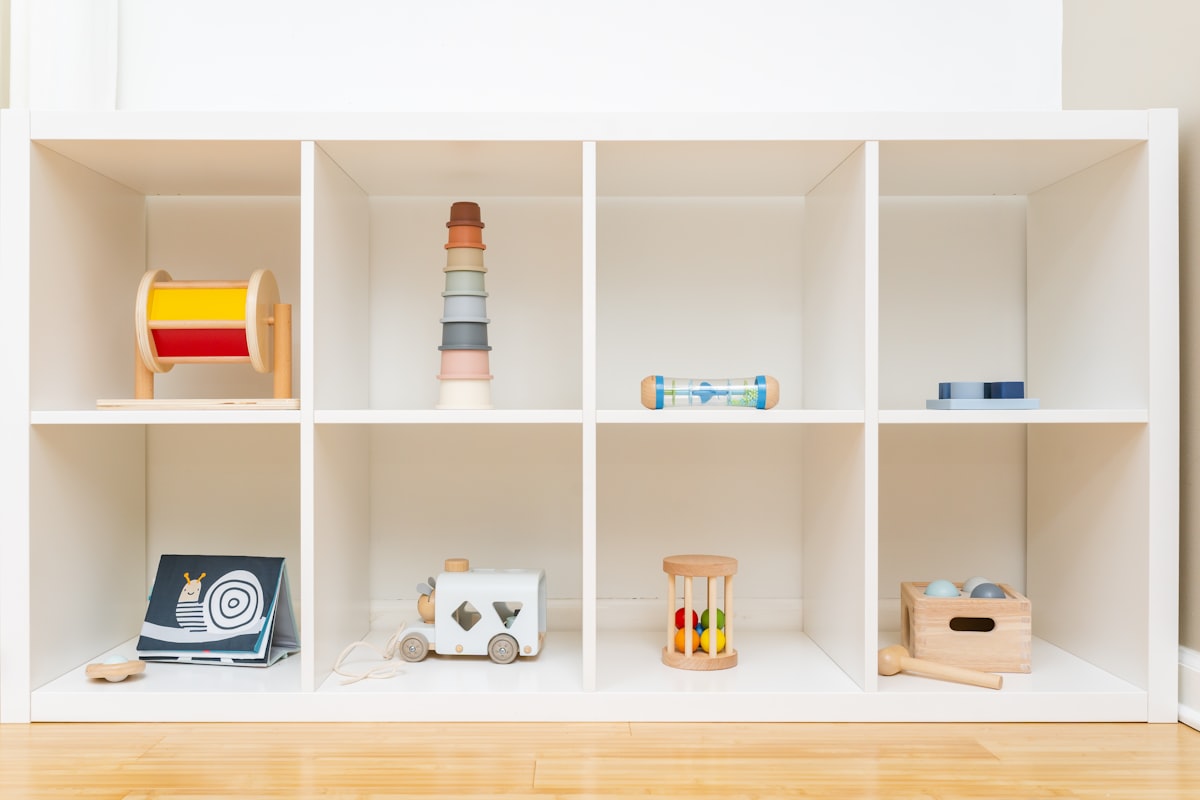
When families invite me into their homes, one of the first things I notice is the playroom. Or more accurately, the absence of one — because most family living spaces have become a kind of toy museum. Every surface, every corner, every basket, filled.
I understand why. Parents want the best for their children. They want to give them every opportunity, every tool, every advantage. And toy companies are very good at making parents feel that one more thing will unlock something.
But in eight years of working with children from birth to school age, the single most consistent and impactful change I make in family homes is not adding a toy. It is removing them.
Why overwhelm is the enemy of play
A child who is surrounded by thirty options will often play with none of them. They will pick something up, put it down, pick up something else. They will demand a parent's attention not because they are bored of play, but because they genuinely cannot find their way into it. The environment is doing too much, which means their brain cannot do its job.
Montessori pedagogy understands this deeply. The prepared environment is one of the most important concepts in the entire philosophy — and prepared does not mean full. It means intentional. It means everything on that shelf has a purpose, a place, and space to breathe around it.
When a child looks at a shelf with three or four carefully chosen items, something shifts. They can actually see what is there. They can choose. And that act of choosing — small, seemingly insignificant — is one of the most important things a young child can do for their developing sense of independence and self-regulation.
What belongs on a Montessori shelf
The honest answer is: whatever is right for your child at their specific stage of development. A shelf that works beautifully for a 14-month-old will be entirely wrong for a 3-year-old. This is why rotation matters so much — not just decluttering, but actively changing what is available as your child grows.
As a general guide, I look for:
- Open-ended materials. Blocks, scarves, baskets, natural objects. Things that become whatever the child's imagination decides they should be.
- Real-world tools at child scale. A small pitcher they can pour from. A basket they can carry. A cloth they can use to wipe a surface. Montessori children learn through doing real things.
- One or two skill-building toys. A puzzle at the right difficulty level. A threading activity. Something that requires concentration and rewards it.
- Beauty. This one surprises parents. Montessori environments are beautiful intentionally. A child who is surrounded by things that are lovely to look at treats those things with care. A room that looks like a landfill is treated like one.
The rotation principle
You do not need to own fewer toys. You need to have fewer toys available at once.
I suggest keeping two-thirds of toys in storage, rotating them every one to three weeks depending on your child's interest level. When you bring something out of rotation, it is genuinely new to them again. The delight is real. The engagement is deeper.
This is also kinder to your budget than buying more. The toys you already own, presented differently, will hold your child's attention far better than a constant stream of new things that lose their novelty in hours.
How to start
If you want to try this at home, here is what I suggest.
Find a low shelf your child can access independently — this matters more than most parents realise. If a child has to ask for every toy, they are not developing independence. They are developing dependence on you. The shelf should be at their eye level, easy to reach, and easy to put things back on. Returning things to their place is part of the work, not the end of it.
Choose four to six items. Put everything else away — not permanently, just out of sight. Observe what your child goes to first. Watch how long they stay with it. You will learn more about your child in one afternoon of observation than in weeks of trying to entertain them.
That is the real secret of the Montessori shelf. It is not just a better way to organise toys. It is a window into who your child is becoming.
If you would like personalised guidance on setting up your child's environment, the Room to Grow service is exactly this — a home visit, an assessment, and a plan built entirely around your child. Learn more here.